 English
 Español
 عربى
 Türk
A 12V car vacuum cleaner is a small handheld unit that runs from the cigarette lighter socket, typically drawing 60–120W (about 5–10A) and delivering 2,000–4,000 mbar of sealed suction. Buy on four things and you will rarely be disappointed: sealed suction in mbar, current draw against the socket's fuse rating, the nozzle set, and how easily the filter can be cleaned.
Picture the usual mess: dry sand worked into the weave of a floor mat, crumbs under a child seat, dog hair wrapped around a seat rail, a scatter of grit in the boot. A full-size workshop vacuum clears it in one pass, but it needs a mains socket and a parking spot close to one. A 12V unit lives in the car, starts in seconds and finishes most of that work — provided the tool is matched to the job rather than to the biggest number on the box.
Content
- What a 12V Car Vacuum Cleaner Really Is
- Reading the Spec Sheet: mbar, Watts and Amps
- Corded 12V or Lithium Cordless: Choose by Where the Dirt Is
- Nozzles and Attachments Do More Than Extra Suction
- Filtration and Dust Cup Design: The Part Buyers Forget
- Build Quality and Procurement Checks
- Matching the Build to the Buyer
- Using a 12V Vacuum Without Damaging the Socket
- FAQ
What a 12V Car Vacuum Cleaner Really Is
It is a DC spot cleaner, not a replacement for a workshop vacuum. A typical corded model is a 0.6–1.2 kg handheld body with a 0.3–0.5 L dust cup, a 3 m cable ending in a cigarette lighter plug, and a motor rated between 60W and 120W.
That description sets expectations correctly. The motor is small, airflow is modest, and the actual cleaning is done by the nozzle concentrating what suction exists onto a narrow area. Understanding this is the difference between a tool used every week and one that ends up forgotten in the spare-wheel well.
| Type | Power source | Typical sealed suction | Runtime | Best for | Watch out for |
|---|---|---|---|---|---|
| Corded 12V (cigarette lighter) | 12V DC socket, 60–120W | 2,000–4,000 mbar | Unlimited while the engine runs | Weekly crumbs, sand, pet hair, roadside tidy-ups | Cable routing, socket fuse limit |
| Lithium cordless | 12–20V battery pack | 3,000–5,000 mbar | 12–25 minutes per charge | Reaching the boot and third row without a cable | Battery ageing, charge time, UN38.3 shipping rules |
| Mains canister or shop vacuum | 230V AC | Highest airflow | Unlimited | Deep seasonal cleaning, wet pickup | Needs a socket, bulky, not portable |
Reading the Spec Sheet: mbar, Watts and Amps
Compare sealed suction in mbar and input power in watts, and ignore inflated "Pa" headlines unless the unit is stated. The conversion is simple: 1 mbar equals 100 Pa, so 2,000 mbar is 20 kPa (20,000 Pa) and 4,000 mbar is 40 kPa.
Then check the electrical side, because this is where most returns come from. Power divided by voltage gives current: a 70W unit pulls roughly 5.8A at 12V, and a 120W unit pulls about 10A.
- Most cigarette lighter circuits are fused at 15A (180W); a number of compact cars use 10A (120W). Confirm before ordering a 150W "peak" model.
- With the engine off, socket voltage sags toward 11.5V and motor speed drops; with the engine running you get 13.8–14.4V and steadier performance.
- A 3 m cable reaches the boot of a saloon from the front socket; SUVs and estates often need 4 m or a rear 12V socket.
| Label figure | What it means in practice |
|---|---|
| 70W, about 5.8A | Safe on a 10A socket, lighter motor, fine for crumbs and dry sand |
| 120W, about 10A | Upper limit for a 10A circuit; noticeably stronger pull on mats |
| 2,000 mbar | Entry level; works with a narrow crevice tool, struggles on deep pile |
| 4,000 mbar | Strong enough for pet hair and rubber mats with a brush head |
| 0.3–0.5 L dust cup | Two to three minutes of heavy sand before it needs emptying |
Corded 12V or Lithium Cordless: Choose by Where the Dirt Is
Pick corded 12V if you clean often and dislike charging; pick lithium cordless if you need to reach the boot, the third row or a driveway without dragging a cable. Corded units cost less, run as long as the socket supplies power and never fade mid-job; cordless units trade 12–25 minutes of runtime for freedom of movement and a battery that ages.
For a family car cleaned weekly, a corded unit kept in the spare-wheel well is the pragmatic choice. For a two-car household where the vacuum moves between vehicles, or for someone detailing cars outdoors, cordless wins on convenience.
A mid-range cordless option should offer a 2-in-1 nozzle set, no cable to route around the pedals, and a body small enough to stay in the boot. The trade-off is a battery that must be charged and, eventually, replaced.
 SX-413 2-in-1 Cordless Handheld Vacuum2-in-1 cordless handheld with long nozzle, compact ABS body and rechargeable lithium battery; suits car-gap cleaning and boot storage where cable-free reach matters.View Product →
Nozzles and Attachments Do More Than Extra Suction
A 2-in-1 or 5-in-1 nozzle set improves real pickup more than 500 mbar of extra sealed suction, because most missed dirt sits in narrow gaps where a wide floor head never makes contact.
What to look for in the box:
- Crevice tool (roughly 8–12 mm wide) for seat rails, handbrake surround and window switches.
- Soft brush for fabric seats and mats — it lifts sand instead of polishing it into the weave.
- Long or flexible nozzle for the gap between seat and centre console, and under the front seats.
- Extension hose so the body can stay on the passenger seat while the nozzle reaches the boot.
Units built around that idea pair a 2-in-1 brush with a higher suction rating, so mats and crevices can be covered with one tool change instead of three.
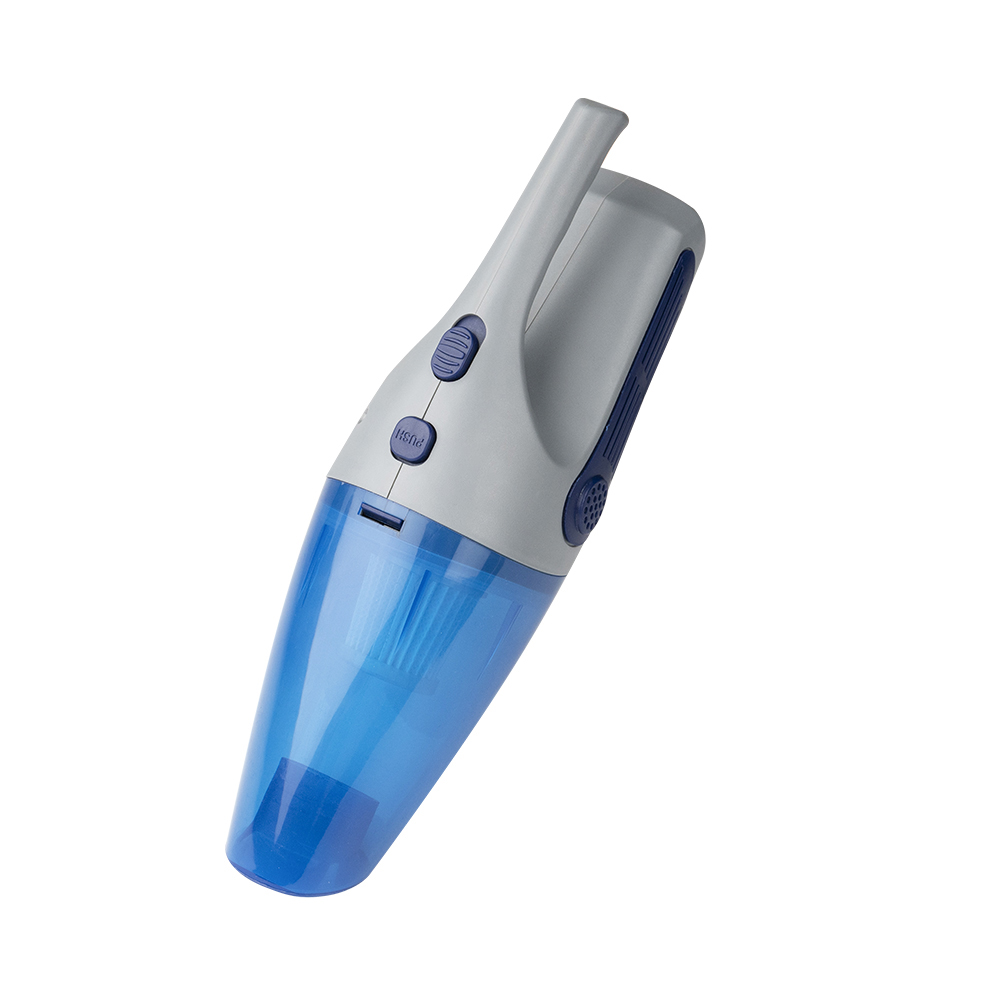 SX-405 2 in 1 vacuum cleaner/brush big suction 4000mbarmatched with suction nozzle and brush for multiple functions, linked to cigar lighter for useView Product →
Filtration and Dust Cup Design: The Part Buyers Forget
A washable filter that can be rinsed and air-dried in ten minutes matters more than a small suction advantage, because a clogged filter is the most common reason a working 12V vacuum feels weak.
Two designs dominate. A cyclone body spins dust away from the filter and holds suction longer on sand; a flat or cylindrical filter with a fabric pre-filter is cheaper and easier to replace. Whichever you choose, check that the dust cup releases with one hand, that the filter is reachable without tools, and that spare filters are listed as a part customers can reorder.
For volume buyers this is also a cost lever: filter media grade, cup wall thickness and the seal between cup and body drive both the bill of materials and the return rate.
Build Quality and Procurement Checks
When buying in volume, the specification sheet is only half the story; the other half is the plug, the switch and the motor.
- Cigarette plug fit: spring contact tension and a built-in 5A–15A fuse. A loose plug arcs and can melt the socket.
- Switch and motor life: ask for cycle-test data on the switch and brush life on the motor rather than a "long life" claim.
- Thermal protection: a cut-out that trips after 10–15 minutes of continuous use is normal; one that never trips is a fire risk.
- Cable and strain relief: 3 m of cable with moulded strain relief at both ends survives being shut in a door.
- Compliance: CE/EMC and RoHS documentation for the electronics; UN38.3 test reports and MSDS for any lithium cordless model.
- Drop and packing tests: a 1 m drop on six faces plus a carton drop test catches most transit damage before it reaches a customer.
This is the ground Yuyao Shuangxin Electrical Appliance Co., Ltd. works on. The company runs a 7,000 m² plant with more than 100 R&D staff, two in-house foundries and a CNC machining shop, plus its own test laboratory — so motor housings, impellers and moulded parts can be controlled rather than bought in blind. The factory sits about 90 km from Ningbo port and develops handheld vacuum cleaners from customer drawings or samples, which shortens the loop between a sample and a production run.
Matching the Build to the Buyer
A 70W corded unit covers private owners, a 120W corded or cordless unit covers weekly detailing, and OEM specification work covers importers who need a private-label version. The full handheld vacuum cleaner range splits along the same line: DC 12V cigarette-lighter models for cost-sensitive volume, and lithium cordless models for markets that pay for convenience.
For a baseline reference point, a small-body 12V 70W machine shows what the glovebox-and-boot role actually requires — compact housing, a crevice tool and a filter that comes out without tools.
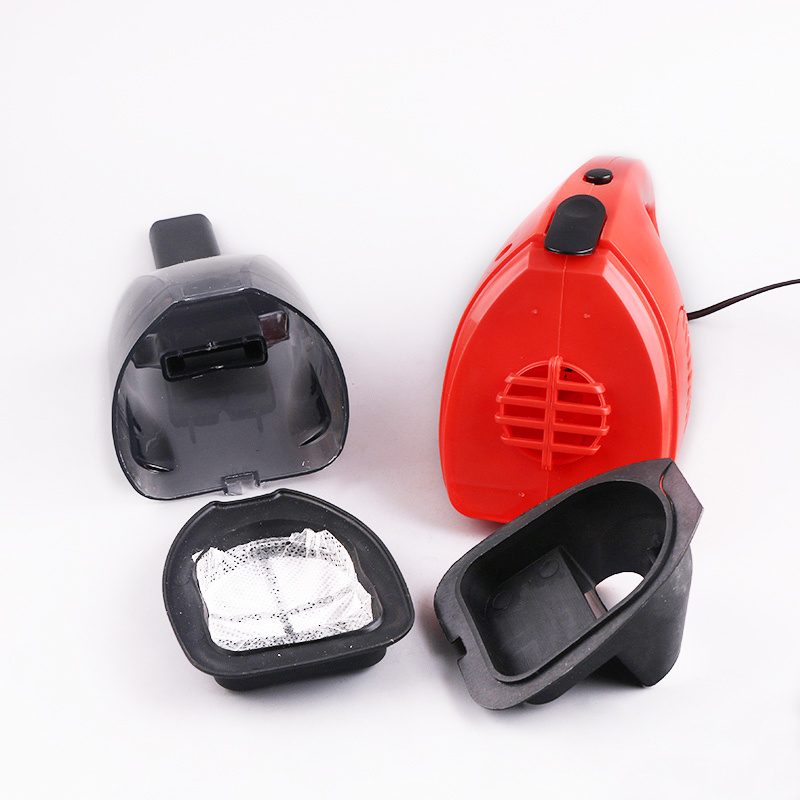 SX-401 12V 70W Portable Car Vacuum CleanerCompact 12V 70W car vacuum powered from the cigarette lighter, with a 3-metre cord for reaching seats, mats and trunk areas; a baseline corded option.View Product →
Buyers comparing a full catalogue rather than a single model can review the handheld vacuum cleaner range to see how corded and cordless bodies differ in cup size, nozzle kits and motor ratings.
Using a 12V Vacuum Without Damaging the Socket
Run the engine while you vacuum, keep sessions under 10–15 minutes, and empty the cup before it reaches the fill line.
- Start the engine so the socket holds 13.8–14.4V and the battery is not drained.
- Plug in with the switch off, then start the motor — this avoids the inrush spike on the fuse.
- Work top down: seats, then console and rails, then mats, then the boot floor.
- Keep the cable clear of the pedals and steering column; route it over the seat, not across the footwell.
- Empty the cup and rinse the filter after every two or three heavy sessions; dry it fully before refitting.
- Unplug after use — a plug left in a live socket can be knocked and short.
If you want a routine to follow, this guide to a vehicle-mounted vacuum cleaner for car cleaning sets out an order of work that keeps a weekly clean under ten minutes.
FAQ
Will a 12V car vacuum cleaner drain my battery?
Not in normal use. A 70W unit draws about 5.8A, so ten minutes of cleaning takes roughly 1Ah from a 45–60Ah battery. Running the engine keeps the socket voltage steady and removes the concern entirely.
Is 2,000 mbar enough for a family car?
Yes for dry crumbs, dust and loose sand when a crevice tool is used. The step to 4,000 mbar is worth paying for when pet hair, rubber mats and ground-in grit are part of the weekly routine.
Why does the vacuum cut out after a few minutes?
Usually one of three causes: a thermal cut-out doing its job, a blown fuse inside the cigarette plug, or a clogged filter and hose. Check the filter first, then the plug fuse, then let the motor cool.
Corded or cordless for a single car?
Corded. One vehicle, one socket and a predictable cleaning spot make the cable a non-issue, and there is no battery to charge or replace.
Can it be used outside the car?
Yes, for dry debris — boot liners, tents, sofa seams, keyboards and pet beds. It should never pick up liquid, ash or fine building dust, which pass through the filter and shorten motor life.
What should an importer request first?
A sample built with production tooling, fuse and thermal cut-out test reports, the spare filter part number, and carton drop-test results. Those four items reveal more about a supplier than a catalogue page.
Choose the suction level for the dirt you actually have, confirm the current draw against your socket fuse, and treat the nozzle set and filter as buying criteria rather than accessories. A 12V car vacuum cleaner specified that way stays useful for years — and stays in the car instead of the garage.