 English
 Español
 عربى
عربى Türk
TürkA portable air compressor with a rechargeable battery earns its place in a car only if it can top up a tyre without help from the car itself. The test is blunt: add 4 psi to a 225/65 R17 tyre in under three minutes, twice in a row, on one charge, with less than 1 psi of gauge error. Tools that pass are worth the space behind the seat. Tools that fail become a plastic box that never leaves the boot.
The reason is structural. A cordless inflator is four subsystems sharing one housing: a DC motor, a pump head, a lithium-ion pack and a pressure sensor. Each part sets a hard limit, and whatever is cheapest inside usually sets the limit for the whole tool.
What follows is a practical breakdown of those limits: how to read the numbers on the box, how many tyres one charge really covers, when cordless beats corded, and what to verify before buying a single unit or ordering a container of them.
Content
- What a rechargeable portable air compressor actually is
- Cordless, corded or manual: what you actually trade
- The five specifications that decide real performance
- How many tyres will one charge handle?
- Where a battery-powered inflator wins, and where it does not
- What to check before buying or sourcing
- Frequently asked questions
What a rechargeable portable air compressor actually is
A rechargeable portable air compressor is a self-contained inflation tool that runs from its own lithium-ion battery pack. It needs no 12 V socket cable, no running engine and no separate power source.
Three power arrangements dominate the category, and they behave very differently in practice:
- 3S packs (11.1 V nominal, 12.6 V fully charged): usually 1,500 to 3,000 mAh. Light and inexpensive, and best suited to bicycle tyres, small car tyres and short top-ups.
- 5S and 6S packs (18 to 21 V nominal): typically 2,000 to 6,000 mAh. They drive a larger motor, move noticeably more air per minute, and suit family cars and SUVs.
- Corded 12 V units: not battery powered at all. They pull 10 to 15 A from the car socket, which is why they slow down when the engine is off and the battery is tired.
Battery voltage, not the psi figure printed on the carton, decides how quickly the pump moves air. A "150 psi" label only says where the pump stops. It says nothing about how long it takes to get there.
Cordless, corded or manual: what you actually trade
Convenience is paid for in weight, price and charge management. The table below compares the realistic options for topping up a 17-inch passenger tyre by 4 psi.
| Option | Power source | Typical fill time | Weight | Best fit | Main weakness |
|---|---|---|---|---|---|
| Corded 12 V, single cylinder | Car socket, 10-15 A | 1.5-3 min | 0.8-1.2 kg | Occasional top-ups at home | Cable tangles; drains the car battery when the engine is off |
| Corded 12 V, double cylinder | Car socket, 15-20 A | 1-2 min | 1.5-2.5 kg | Faster work on larger tyres | Higher current can blow a 15 A socket fuse |
| Cordless, single cylinder | Internal 3S Li-ion pack | 2-4 min | 0.6-1.2 kg | Bikes, scooters, small cars | Fewer fills per charge; slow on SUV tyres |
| Cordless, double cylinder | Internal 5S or 6S Li-ion pack | 1.5-3 min | 1.5-2.5 kg | Family cars, road trips, several tyres | Heavier; needs charging discipline |
| Manual foot pump | Muscle | 3-8 min | 1.5-2.5 kg | Emergency backup | Effort; poor gauge accuracy |
| Inflator and jump starter combo | Internal Li-ion pack | 2-4 min | 2-4 kg | Cars that will not start | Bulkier and more expensive |
The five specifications that decide real performance
Battery pack: compare watt-hours, not milliamp-hours
The useful number is watt-hours, which is nominal voltage multiplied by amp-hours. A 3S pack rated 11.1 V and 2,000 mAh stores roughly 22 Wh, while a 21 V pack rated 4,000 mAh stores roughly 84 Wh, close to four times the usable work. Two packs both labelled "4,000 mAh" are not comparable if one runs at 11.1 V and the other at 21 V. A replaceable pack is also worth paying for, because the battery is normally the first part to fade.
Pump head: single versus double cylinder
A double-cylinder head moves roughly 1.6 to 2 times the air per stroke, which is why it fills faster. The cost is weight, an extra 3 to 6 dB(A) of noise, and higher current draw. For a standard 225-section tyre, a single cylinder is enough. For LT tyres, repeated use or a commercial fleet, the double-cylinder layout pays for itself.
Duty cycle and thermal cut-off
Most compact inflators are rated for about 8 to 10 minutes of continuous running followed by a 10 to 15 minute cooldown. Pushing past that heats the cylinder, thins the lubricant and shortens motor life. A thermal cut-off that stops the pump is a feature, not a fault.
Gauge accuracy and automatic shut-off
Digital sensors typically hold within about 1 psi, while analogue dials often drift 3 to 5 psi. Automatic shut-off at a preset target matters more than a higher pressure ceiling: a 150 psi pump that stops itself reliably beats a 200 psi pump you have to watch. Verify the reading against a known-good gauge once, then trust the offset.
Charging, storage and night-time use
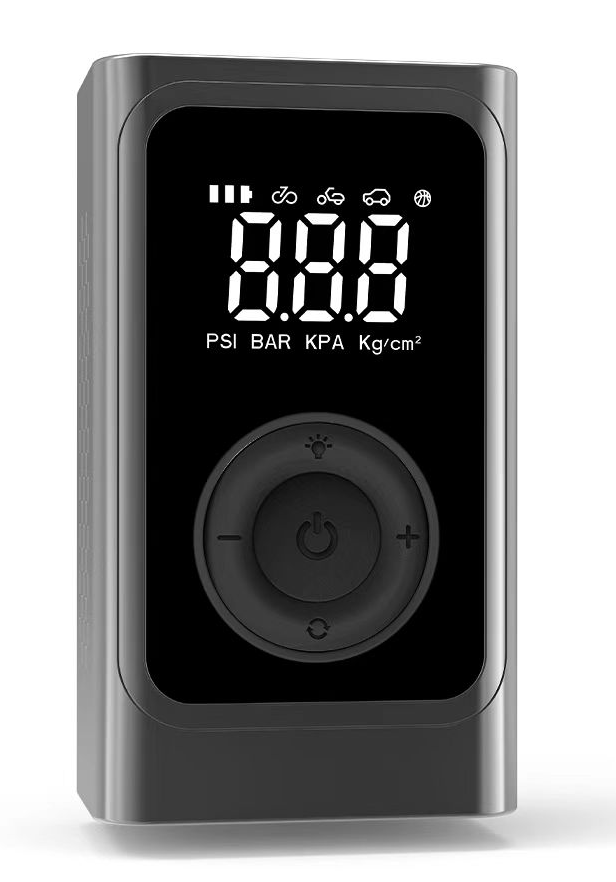
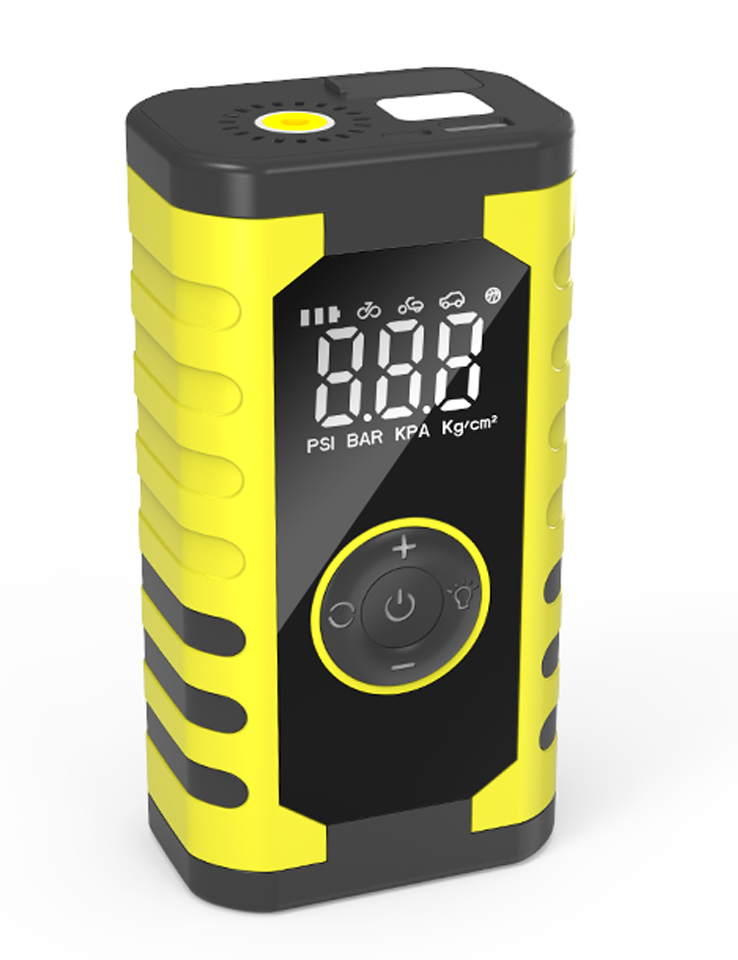
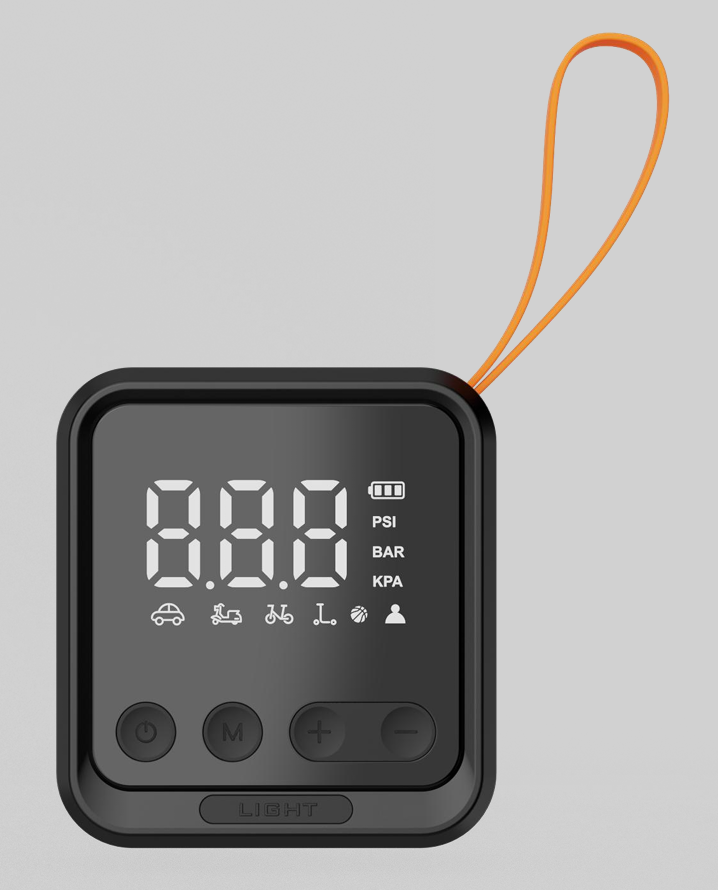
USB-C charging with a 5 V/2 A input refills a pack in two to four hours, and a built-in LED makes the tool usable on a dark shoulder. Units that combine a USB charging interface with an LED work light remove two separate items from the boot.
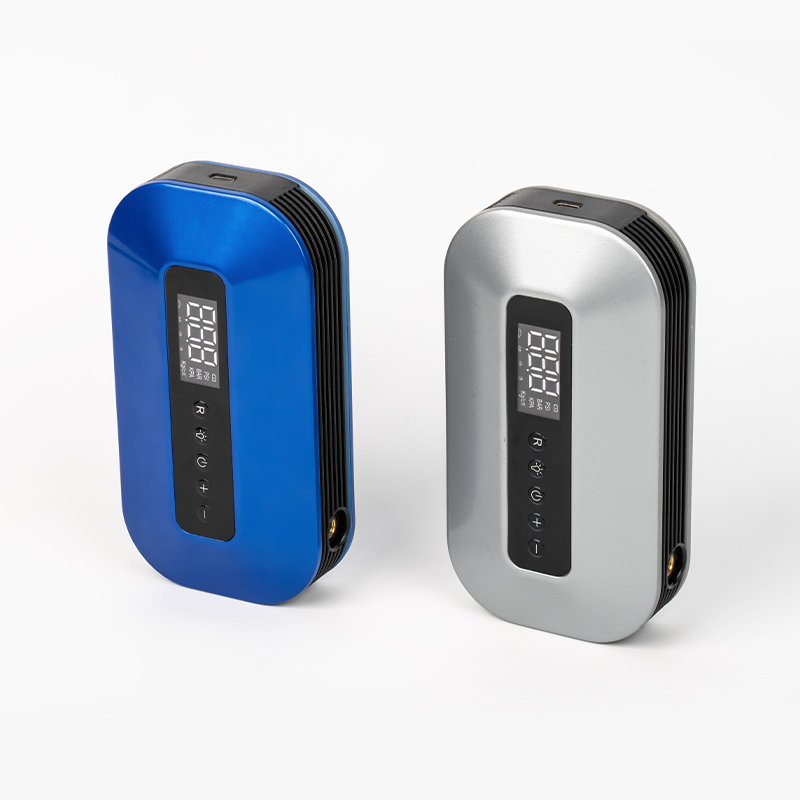 SX-303 Portable USB-Chargeable LED Air CompressorCompact 7.4V lithium-battery inflator with digital display, LED light, and USB charging; two 2000mAh cells support on-the-go emergency tire inflation.View Product →
How many tyres will one charge handle?
As a planning rule, a healthy 11.1 V pack around 2,000 mAh covers two to three top-ups of a passenger tyre, or a single tyre from flat to 32 psi with little left over. An 11.1 V pack near 4,000 mAh covers four to six top-ups. A 21 V pack between 4,000 and 6,000 mAh covers six to ten top-ups, or one flat SUV tyre plus two more top-ups.
Treat those as planning figures rather than promises. Ambient temperature, tyre volume, target pressure and a leaking hose connection all move the number. Cold weather alone can cut usable capacity noticeably, and a tyre that has sat at 24 psi overnight takes far longer than one losing 2 psi over a month.
For frequent use, start from a design built around a large-capacity pack and a fast-inflation pump head rather than a headline psi rating, because the pump that finishes sooner draws less total energy from the pack.
 SX-301 Digital Mini Air Compressor for Fast Tire InflationPortable 7.4V lithium-battery inflator with digital pressure display and three 2000mAh cells, providing 30-minute runtime for precise on-the-go tire inflation.View Product →
Where a battery-powered inflator wins, and where it does not
Cordless inflation is not a universal replacement for a workshop compressor. It is excellent in a narrow set of situations and poor in a few others, and knowing the difference prevents disappointment.
Strong use cases
- A kerbside flat on a cold morning, with no socket within reach.
- Monthly pressure checks on two or three household cars.
- Motorcycles, bicycles, e-scooters, wheelbarrows and sports balls.
- Rental, car-sharing and delivery fleets, where speed of check matters more than volume of air.
- A car that will not start, when inflation and jump-starting are needed in the same moment.
Weak use cases
- Re-inflating a tyre that leaks steadily, which needs repair, not air.
- Light truck and commercial tyres that need 80 psi or more.
- Continuous air-tool work, which belongs to a tank compressor.
- Long off-road sessions with repeated deflation and re-inflation, unless you carry spare packs.
If you drive an older car, the combination of wireless inflation and jump-starting in one housing is a genuinely practical answer, because the two failures tend to arrive together: a weak battery and a soft tyre on the same cold morning. Reliability in that scenario comes down to pack quality and a pressure sensor that does not drift, which is covered further in this note on cordless inflators in emergency use.
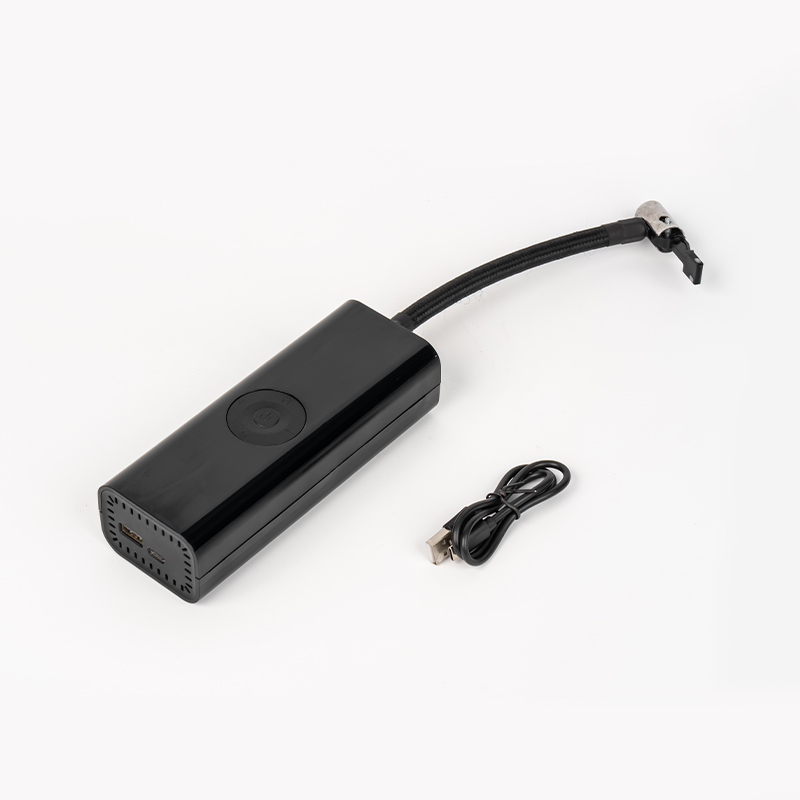 SX-306 Multifunctional Wireless Inflator and Jump StarterMultifunctional 8000mAh inflator and jump starter with 12V output, 500A starting current, 1000A peak, 100Psi, USB charging, and LED lighting for roadside or camping use.View Product →
What to check before buying or sourcing
Whether you buy one unit for your own car or source a container for retail, the same short list separates a tool that lasts from one that disappoints in month three.
- Watt-hours of the pack, calculated from nominal voltage and capacity.
- Whether the pack is replaceable, and whether spares will still exist in two years.
- Chuck type: a screw-on connector holds pressure better than a worn lever clamp.
- Automatic shut-off plus a digital gauge, rather than a dial you must watch.
- Hose length and how it is stored, since a stiff hose in cold weather is the most common complaint.
- Duty cycle and thermal protection, especially if the tool is used commercially.
- Storage temperature limits, because a pack left on a hot dashboard ages quickly.
- Charging standard and input rating, so the tool can share cables with a phone.
On the sourcing side, the questions shift to tooling, calibration records, cell sourcing and after-sales support. A manufacturer such as SHUANGXIN, based in Yuyao, Zhejiang, illustrates the pattern worth looking for: a 7,000 square metre plant, two in-house foundries and a CNC machining shop for the metal parts, and an in-house test laboratory for pressure and durability checks, all within about 90 km of Ningbo port for export shipments. That combination of casting, machining, assembly and testing under one roof is what keeps gauge accuracy and pack quality consistent between production runs, and it is also why OEM and ODM work can start from a drawing or a sample rather than a catalogue number.
Frequently asked questions
Is a 150 psi rechargeable compressor enough for a car tyre?
Yes. Passenger car tyres usually need 30 to 36 psi and SUV tyres 33 to 40 psi, so a 150 psi pump has ample headroom. What matters is how fast it reaches that pressure, not the ceiling.
How long does one charge last?
Expect roughly 8 to 15 minutes of total motor runtime on a compact unit, which translates to two to six tyre top-ups depending on pack size, tyre volume and temperature.
Can it fill a completely flat tyre?
Yes, but allow two to four times the usual duration and work in two cycles with a rest between them. Seating a bead is a different job and belongs to a tank compressor.
Is it safe to leave the compressor in the car?
Storing it in the car is convenient, but keep it out of direct sun and away from a hot dashboard. Sustained heat above roughly 45 C accelerates lithium-ion ageing and reduces capacity.
Corded or cordless for road trips?
Cordless. A corded unit depends on the car battery and a socket, which are exactly the things that fail when you need air most.
Do I need a double-cylinder model?
Only if you run larger tyres, check several vehicles, or want shorter fill times. For one small car and occasional bike tyres, a single-cylinder 21 V unit is lighter and cheaper.
A rechargeable portable air compressor is not a complicated product, but it is easy to buy badly. Check the watt-hours rather than the milliamp-hours, insist on automatic shut-off and a digital gauge, respect the duty cycle, and keep the pack out of a baking glovebox. Do those four things and the tool will still be doing its job on the morning you actually need it.